
October 7 and 8, 2025 (online)
Call for Abstract
Over the past five years, the Symposium has aimed to promote research by Representation scholars that connects Augmented Reality (AR) technology with the discipline of Artificial Intelligence (AI).
The breadth of interests that emerged during the past Symposiums, coupled with the now usual very rapid development of technologies, tools and devices, now requires a (controlled) expansion of the theoretical content and application areas of the present call of REAACH 2025 Symposium, as well as careful monitoring of the disciplines that can be involved, starting with the AI-XR pair. XR, an acronym for extended reality, has emerged in recent years as a concept encompassing AR, VR (virtual reality), and MR (mixed reality), offering new ways of interacting with the real. In this sense, the fields of application open to the worlds of tangible and intangible cultural heritage, architectural, environmental, infrastructural, and product design, and education, as a place for advanced training and as a tool for educational enhancement.
REpresentation Advances And Challenges Symposium intends to explore, through the lens of Representation, the research areas that gravitate around AI-XR, opening up new transdisciplinary thinking.
Authors are asked to submit projects whose experimentation is ongoing at the time of abstract submission and is in an advanced stage of development, which should be adequately documented at the time of presentation at the Symposium.
Topics and Keywords
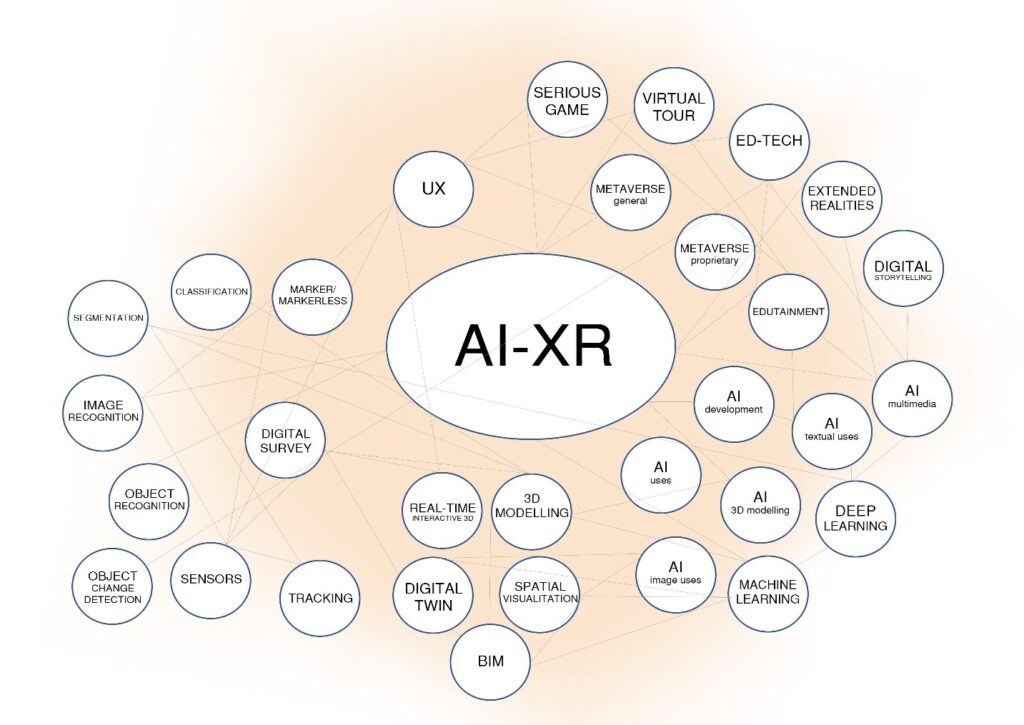
Considering the above, the REAACH Association Research Board has developed a graph that, in terms of centrality, creates relationships with research topics related to AI-XR content, aligning with the interests of the Symposium. Authors are asked to respond to this by identifying 5 keywords for their proposal, of which at least 1 must be related to AI and XR, at least 1 must be associated with AI-XR, and 2 or 3 can be free.
The exact keywords selected for drafting the abstract must be used for drafting the paper.
Deadlines
20/06/2025 – Abstract submission deadline- 30/06/2025 – Postponed abstract submission deadline
15/07/2025 – Abstract acceptance for oral or video communication- 23/07/2025 – Abstract acceptance for oral or video communication
- 23/07/2025 – Opening inscriptions (authors, membership, event participation)
- 20/09/2025 – Fee payment deadline and registration – oral or video presentation (one author x work)
- 25/09/2025 – Fee payment deadline and registration for REAACH 2025 membership
- 30/09/2025 – Free online registration deadline for auditors
- 7-8/10/2025 – REAACH Symposium online
15/11/2025 – Invitation to authors to submit an extended paper as directed by the Scientific Committee- 20/11/2025 – Invitation to authors to submit an extended paper as directed by the Scientific Committee
- 15/01/2026 – Deadline for submission of extended paper
28/02/2026 – Notification of the revisions- 15/04/2026 – Notification of the revisions – new date
Abstract Submission
To submit the abstract, authors are asked to fill out the form available at the end of the section, sending the title, 5 keywords (chosen as explained above), and an abstract in English between 400 and 500 words excluding essential bibliography of up to 5 texts, accompanied by an image by 20/06/2025. Following peer review of the abstract, oral or video presentation proposals can be granted. We remind that at least one author per accepted abstract will be required to pay a fee (70 euros) to present their contribution at the Symposium. Other authors and auditors may attend free of charge. The link for registration for the Symposium will be made public after the acceptance of the abstracts.
Symposium Registration
The registration form allows you entering your personal data with 3 alternative options:
- 1) REAACH online partecipation – If you just want to listen, it’s free! Registration allow you to receive the link one day before the Symposium.
- 2) REAACH association membership – If you would like to join the REAACH community and researcher network, you need to register and pay 20 euro fee. Registration includes REAACH online partecipation.
- 3) REAACH presentation – if you have an oral or youtube communication, at least one author have to register and pay 70 euro fee. Registration includes REAACH association membership and REAACH online partecipation.
REGISTRATION DEADLINE FOR AUTHORS: 20 SEPTEMBER 2025
Instructions for Authors (Long Oral and Video Presentations)
Authors who have received the acceptance e-mail are asked to prepare a presentation according to the attached template:
Language: Slides must be in English. Besides, using English as a spoken language is strongly suggested to facilitate everyone’s understanding.
Exposure time: For Oral presentations, the time is 10-12 minutes, while for Video presentations (you must record your voice with slides presentation), it can be between 8-10 minutes long, not going below 8 minutes.
Long presentation delivery: Oral presentations do not have to be delivered. It is up to the author to check if they work correctly before the Symposium. For Video presentations, the files (in .mp4 format) with voice must be at most 150 Mb and must be delivered by 02/10/25 to be uploaded on the REAACH youtube channel before the event. To send the Long Video, you can use the link below:
Symposium Organization
The symposium takes place over two days online on a zoom platform. Depending on the number of abstracts and the content covered, they are divided into “oral” and “youtube” presentations. Oral presentations are scheduled over the two days with 10-12 min slots. Youtube presentations are videos created by the authors (same lenght, minimum of 8 minutes) that are uploaded to a dedicated youtube channel and made available before the event. Both types of presentations can be included in the final publication.
Keynote Speakers
REAACH Symposium 25 is pleased to announce 4 keynotes and 3 talks during the event:
STAP Reabilitação Estrutural, Portugal

RED.AI Id Pattern: Stone Deterioration Patterns with Multi-Agent Systems
The Id Pattern system within the RED.AI project (Reabilitação Estrutural Digital através da AI) consists of an agentic system designed to assist in the identification of stone deterioration patterns. Traditional methodologies, based on direct observation by expert teams, are accurate but costly in terms of time and resources. The system developed here introduces and evaluates a multi-agent artificial intelligence (AI) system, designed to simulate collaboration between experts and automate the diagnosis of stone pathologies from visual evidence. The approach is based on a cognitive architecture that orchestrates a team of specialized AI agents which, in this specific case, are limited to five: a lithologist, a pathologist, an environmental expert, a conservator-restorer, and a diagnostic coordinator. To evaluate the system we selected 28 difficult images involving multiple deterioration patterns and detected a huge boost in performance of our system compared to the foundational model.
MVRDV – Architects

Integrating generative AI tools within the design process
As generative AI becomes an increasingly useful tool in the design process, the question for us at MVRDV Next isn’t just how to use these tools—but how to leverage them as streamlined, empowering tools for every architect across our studio.
This lecture explores how MVRDV is working to harness AI’s potential through customized methodologies that improve our control and design precision. Likewise, at MVRDV Next, we’re focused on developing AI workflows that augment the creative process through participatory and collaborative strategies. This presentation shows a summary of our journey, combining experimental and practical projects to develop multimodal approaches and iterative processes in our effort to explore new ways to develop projects and tell architectural stories.
Politecnico di Torino, Italy
Politecnico di Torino, Italy


Prompting the city. Understanding GenAI uses for city-making
Generative AI (genAI) is rapidly transforming architectural practice, enabling new approaches to ideation, project development, and even normative compliance. While professional firms are increasingly embedding these tools into their workflows, everyday users also experiment with genAI in playful, provocative ways, producing speculative visions of the city that circulate widely on social media. This talk explores how such spontaneous, serendipitous practices can be leveraged for participatory city-making. By bridging professional and non-professional uses of genAI, we suggest new pathways for integrating public imagination into architectural and urban design processes.
Paper submission
At the end of the Symposium, participants who have presented an oral or video contribution will be asked to write an extended paper in English, which will develop the content presented and which, upon acceptance through peer review, will be published as a book chapter in a volume of the Digital Innovations in Architecture, Engineering and Construction series published by Springer.
The paper will be prepared in accordance with paper template which will be supplied to the authors after REAACH symposium. All the information related to the paper submission (the template document, authors guidelines and table of figure) will be communicated by the email info@reaach.eu
Symposium Committees
Promoting Committee:
- Andrea Giordano (University of Padua)
- Michele Russo (Sapienza University of Rome)
- Roberta Spallone (Politecnico di Torino)
Scientific Committee:
- Violette Abergel (MAP UMR 3495 CNRS/MC, Marseille)
- Salvatore Barba (University of Salerno)
- Marco Giorgio Bevilacqua (University of Pisa)
- Stefano Brusaporci (University of L’Aquila)
- Valeria Cera (University of Naples Federico II)
- Pilar Chías (University of Alcalá)
- Francesca Fatta (Mediterranea University of Reggio Calabria)
- Andrea Giordano (University of Padua)
- Dominik Lengyel (BTU University of Technology Cottbus-Senftenberg)
- Alessandro Luigini (Free University of Bozen-Bolzano)
- Federica Maietti (University of Ferrara)
- Barbara Ester Adele Piga (Politecnico di Milano)
- Pablo Rodriguez Navarro (University Politècnica de València)
- Michele Russo (Sapienza University of Rome)
- Cettina Santagati (University of Catania)
- Alberto Sdegno (University of Udine)
- Roberta Spallone (Politecnico di Torino)
- Victoria Szabo (Duke University)
- Ornella Zerlenga (University of Campania “Luigi Vanvitelli”)
Organizing Committee:
- Rachele Angela Bernardello (University of Padova)
- Martina Casciola (Sapienza University of Rome)
- Giulia Flenghi (Sapienza University of Rome)
- Isabella Friso (IUAV University of Venice)
- Fabrizio Natta (Politecnico di Torino)
- Valerio Palma (Politecnico di Torino)
- Federico Panarotto (University of Padova)
- Enrico Pupi (Politecnico di Torino)
- Martina Rinascimento (Politecnico di Torino)




con il Patrocinio dell’Unione Italiana per il Disegno

con il Patrocinio dell’Associazione img network aps